House rules
Every games box has a rule sheet. This is ours: what we won't do to children, how a project runs, what it costs, and the questions people ask before they call.
- 1
A round ends
Five minutes or fifty, a session has a natural end and the game says so. We'd rather a child came back tomorrow than couldn't put it down.
- 2
No streaks, lives or countdown timers
A missed day shouldn't feel like a loss to a seven-year-old, and a clock turns spelling into panic. Our games pick up where the child left off, whenever that is.
- 3
Nothing to buy, nothing left to chance
Rewards come from learning, by rules anyone can read. No coins, no shop, no mystery boxes.
- 4
Nothing to leak
Our games work without a child's name, email or photo. Children join with a class code, a picture and a secret word. No adverts, no third-party tracking, and designed around the Children's Code.
- 5
Measure learning, not minutes
We agree up front what learning looks like, build the game to show it, and report on that. If a mechanic keeps children playing but doesn't help them learn, it comes out.
- 6
Parts, not platforms
You can take one piece without buying the lot, and leave without losing your data. Everything we make has a documented API.
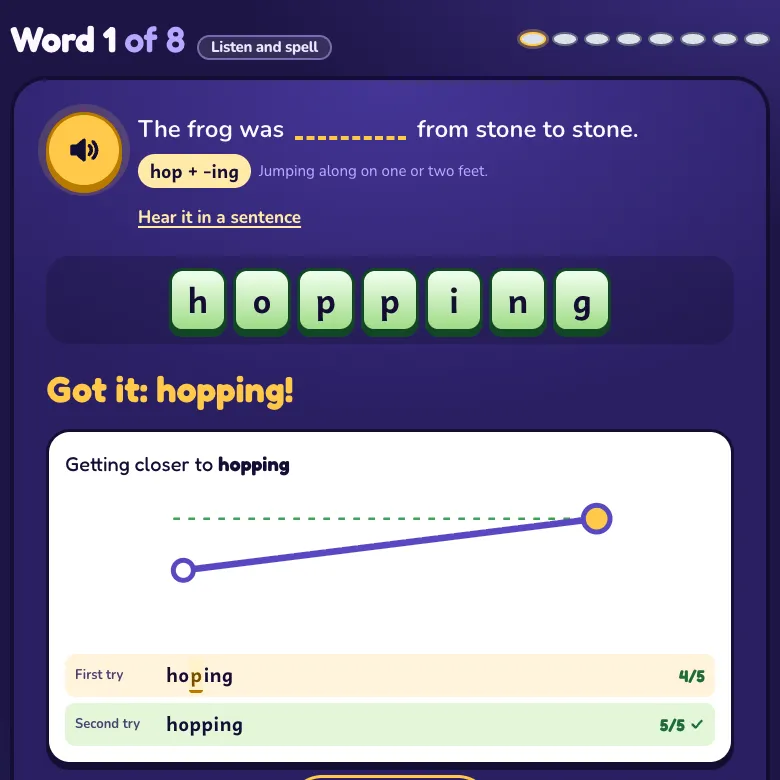
- A second go counts, and it's shown as progress.
- The line only goes up. There's no score to lose.
How a project runs
- 1
A conversation
An hour
What should children learn, who are they, and what would success look like for you. If a game isn't the answer, we'll say so.
- 2
Sprint
2–4 weeks
A fixed-price prototype, sessions with children, and a costed plan.
- 3
Build
Typically 8–16 weeks
A playable build every fortnight, which you can put in front of anyone. Content, art, sound and the grown-up view, built together.
- 4
Launch
A week or two
Accessibility and privacy checks, load tests, a launch plan. We host it, or hand it over.
- 5
Looking after it
Ongoing
We watch what's being learned, fix things quickly, and suggest what to change next.
You can stop after any step and keep what it made.
What it typically costs
These are the ranges most of our work falls into, before VAT. They aren't quotes: you get a fixed price after a first conversation.
Just want one of the parts? Buddies has self-serve plans from free, with no call needed.
| What | How long | Typically |
|---|---|---|
| Prototype sprint, for any of the three | 2–4 weeks | £12k–£30k, fixed |
| Commissioned game, learning or branded | 8–16 weeks | £40k–£120k |
| Pick-and-mix pieces, self-serve | An afternoon | Free to start |
| Help fitting the pieces | 1–3 weeks | £4k–£15k |
| Studio retainer | Monthly | From £6k a month |
| Engine licence | Yearly | From £18k a year |
Things people ask first

Are these prices real?
They're where most of our work lands, so you can plan a budget. Every piece of work gets a fixed quote after a first conversation, and a sprint is always fixed price.
Do you only make games for children?
Mostly for ages 4 to 14, because that's where our products are and where we know the rules best. The same approach works for older learners, and we're happy to talk about it.
Can we use just one part, like the characters?
Yes, that's the point. Buddies works on its own, with or without rewards, and you can start on the free plan today without talking to us.
Who owns what we make together?
You own your content, your brand, your art and the data your users create. We keep our engine and shared parts, which is why a commission costs less than building from nothing, and you get a licence to use them for as long as you need.
How do you handle children's data?
By collecting as little as possible. Our games are designed to work without names or contact details, and we'll help you with the data protection impact assessment for anything we build together.
Do you work with other studios and agencies?
Yes. We're glad to supply the learning design and engine while someone else leads the game, or to work inside your team.
Can it go in our app, not just on the web?
Yes. Everything is web-first, so it runs in a browser, in an app's web view or on a classroom board, and the APIs work from any language.
Something else? Ask us