Set it up your way
Set what they work towards. The world follows.
A plan for each child, with presets for Reception, the 7+ and the tables check, and settings at four levels: school, class, home and child. Locks hold, and access needs always stay on.
What it covers
The world bends to what they're working towards
Each child has a plan: their goals (an exam and a date) and their topics. Choose a preset, or fine-tune topic by topic. The town, games, cards and counts reshape to fit.
- Everything for their year
- Everything Tuckbox has for their school year.
- Reception
- Number, sounds, feelings and stories from the early years framework, played with a grown-up.
- 7+ only
- Number, measures, picture puzzles, English, reading, spelling and the 2, 3, 4, 5 and 10 times tables.
- Year 4 tables check
- All the times tables, with the check practice in the check room.
- Times tables only
- Just the times tables.
- Spelling only
- Just spelling.
Or fine-tune: times tables (and which ones), spelling, number, measures and shape, picture puzzles, English, and reading and writing. Every switch says what it changes in the child's world, such as "the Word Quarter in their village, the library, the Spelling page in their binder".
How the world bends
Nothing out of the plan is drawn. A building that isn't needed becomes an ordinary cottage, orchard, park or pond. A street's name changes to fit ("Puzzle Lane", "Story Row").
Nothing looks missing. Counts, ladders, the binder and the Today board count only what's in the plan, so a child is never shown as behind on something that isn't in their plan.
Nothing earned is taken away. Anything with progress in it stays, just quiet. Switch it back on and it carries on.
The plan never locks. Locking belongs to learning. A grown-up's switch only shows or hides, and a goal never hides a game.
Who sets it
The plan follows the same levels as everything else, and each level can only narrow what's above it. A school admin chooses the topics the school has; a teacher sets the class's plan and goals, or one pupil's; a parent sets their child's plan at home. A child in a class and a family has the class's plan at school and the family's at home. Changes are in the audit log and in the child's data export.
- TuckboxSafe defaults for everyone.
- SchoolA look for the school, and anything it wants every class to share. It can lock a setting.
- ClassThe teacher's choices: which games are on, the pack, how firmly learning comes first.
- HomeA grown-up's choices on a home device, wherever the school or class hasn't locked them.
- ChildTheir own box colours, their theme and their access needs.
Access needs add up. On at any level means on. Nobody below can turn them off.
Some things only tighten. A parent can switch the tables check or the clock off, never back on.
Lists only narrow. If the class switches a game off, home can't switch it back on.
Schools and teachers can lock. A locked setting stays as it was set, all the way down. Today's job first, once a teacher turns it on, can't be turned off at home.
What can be set
- The plan
- A preset or your own mix of topics, and any goals with their dates. The world follows.
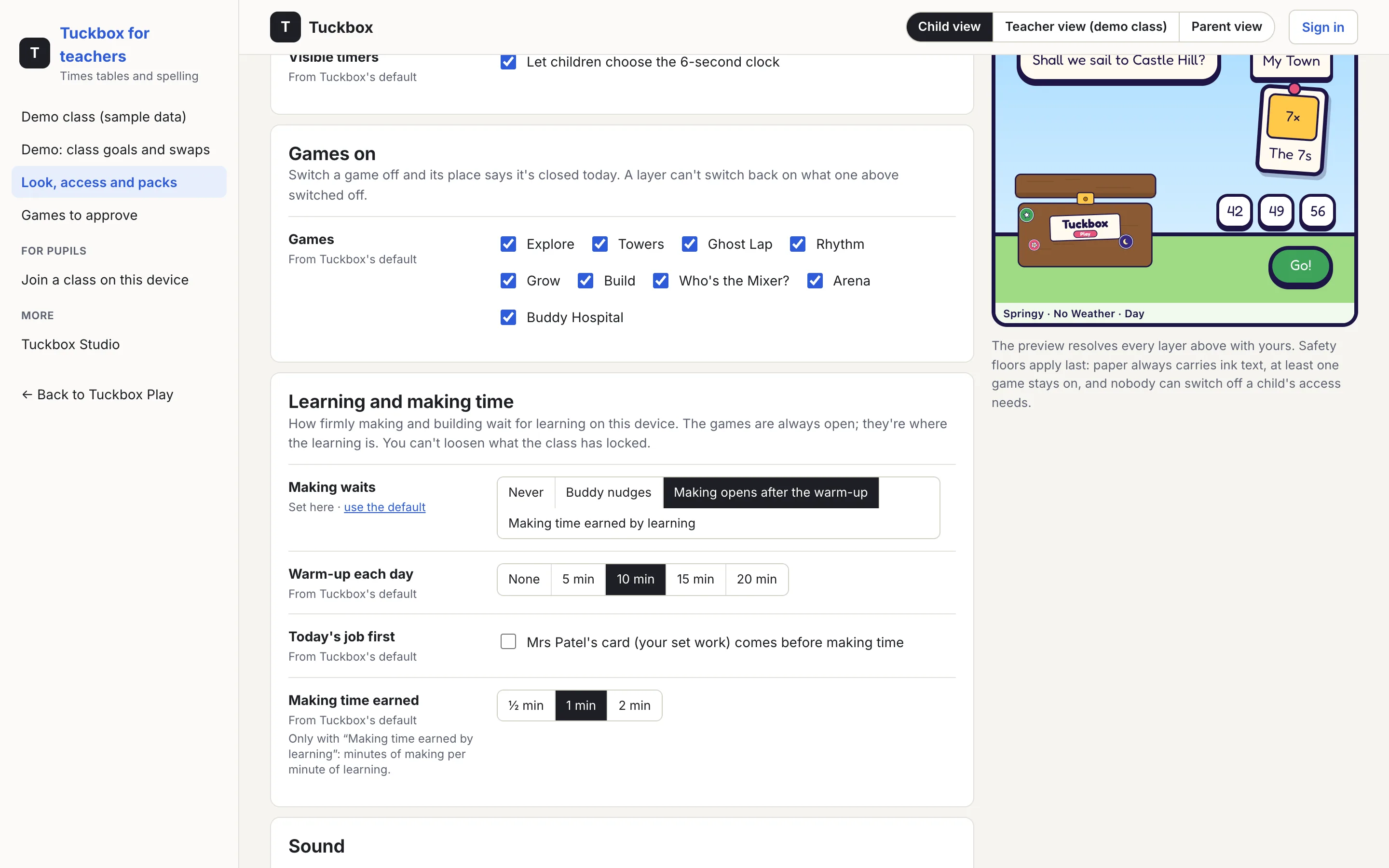
- Games on
- Switch any game off and its building says it's closed today.
- Learning before making time
- Never, Buddy nudges, after a warm-up, or earned by learning. Warm-up length and today's job first, too.
- Tables check practice
- Opt in or out of the Year 4 check practice in the check room.
- Visible timers
- Let children choose a 6-second clock, or hide every clock. Speed is still measured quietly.
- Themes
- The look of the box and the world, and which theme tins children may pick.
- Season and time of day
- Snow in winter, dusk, or night.
- Voice and sound
- The Buddy reading aloud, and the game sounds.
- Access needs
- Reduced motion, a dyslexia-friendly font, high contrast, larger buttons and bigger text.
Themes
Themes for the box and the world
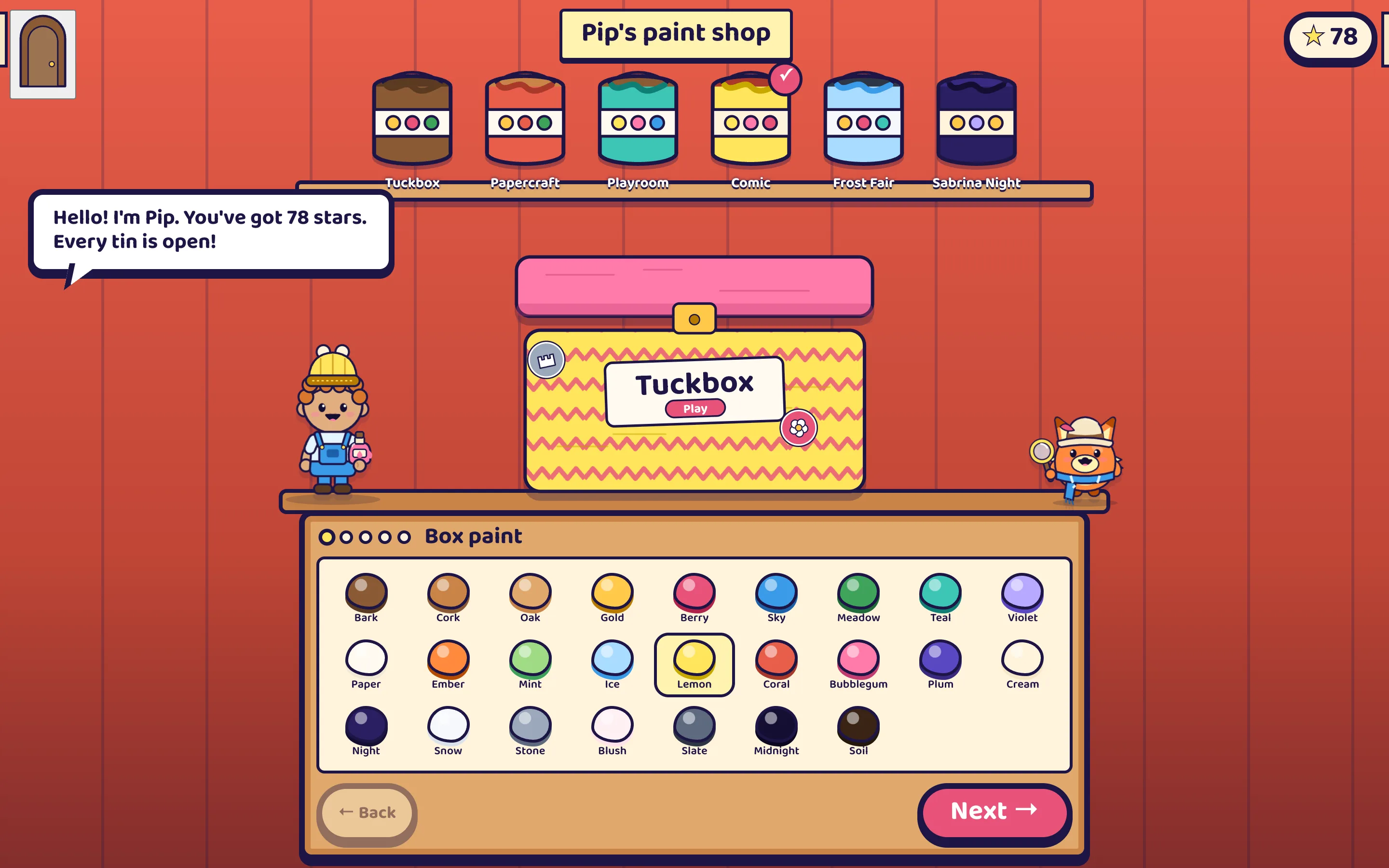
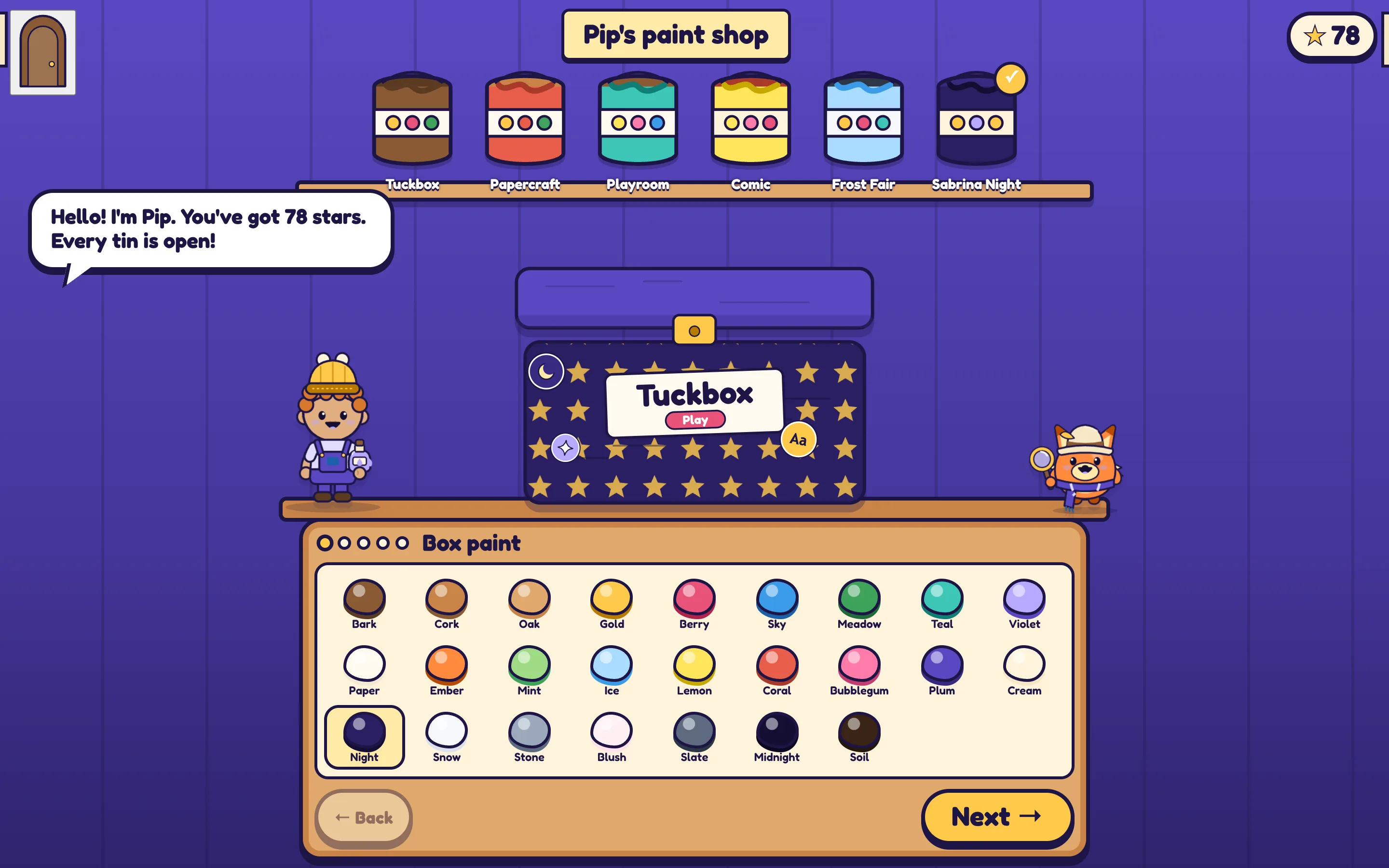
Pip's paint shop repaints the child's box and the world outside: Papercraft, Playroom, Comic, Frost Fair, a starry night and the Tuckbox colours. A class can keep children to a few.