The early years foundation stage
Number, sounds, feelings and stories, from the early years framework every Reception class follows. Played with a grown-up beside the child, who marks some answers. Sounds only use what the class has been taught.
For teachers and parents
The three goals it works towards and what it doesn't cover, how getting ready for a test works, the curriculum it follows, and the research it is built on.
Number, sounds, feelings and stories, from the early years framework every Reception class follows. Played with a grown-up beside the child, who marks some answers. Sounds only use what the class has been taught.
Independent schools' entry assessments for Year 3. Each school sets its own papers. Tuckbox Play covers every skill they test across number, measures, non-verbal reasoning, English and reading, with writing marked by a grown-up.
25 questions on the tables up to 12 × 12, six seconds each, on a screen. Every child in Year 4 in England takes it.
Tuckbox Play practises the whole 144-square grid. Because 6 × 7 and 7 × 6 are the same fact, that's 78 facts tracked for each child, and 66 of them, from 2 × 2 to 12 × 12, are the ones the check asks. A child only Knows it once they've got it right first time, three times in a row, with at least two of those answers inside six seconds. The check room has a practice in the same shape. A child can choose the six-second clock, and a school can switch clocks off altogether.
These are England's tests and England's national curriculum. Mapping for Wales, Scotland and Northern Ireland, which follow their own frameworks, comes next. Tuckbox Play is not a phonics programme and doesn't prepare for the Year 1 phonics check.
Getting ready for a test
A grown-up at home or a teacher sets a target for a child or a whole class: the Year 4 tables check, this year's spelling list, or the 7+. The date fills itself in from the child's year (the first week of June for the tables check) and can be changed.
Practice leans towards it. For the tables check, the 6s, 7s, 8s, 9s and 12s come up more, and so do the facts the child doesn't know yet. It's a weight, never a lock: nothing else disappears.
It never says "will pass", and it never predicts a score.
Maths. By the end of Year 4, children should recall multiplication and division facts for tables up to 12 × 12. Tuckbox Play treats 7 × 8, 8 × 7, 56 ÷ 7 and 56 ÷ 8 as one fact, so a child who knows it one way round gets the credit for all four.
Spelling. Appendix 1 lists the patterns for each year group, from adding -ing to words ending in e, through -tion and -cian, to silent letters. The spelling map groups them into ten regions, and a teacher can set any of them as the day's job.
What teachers see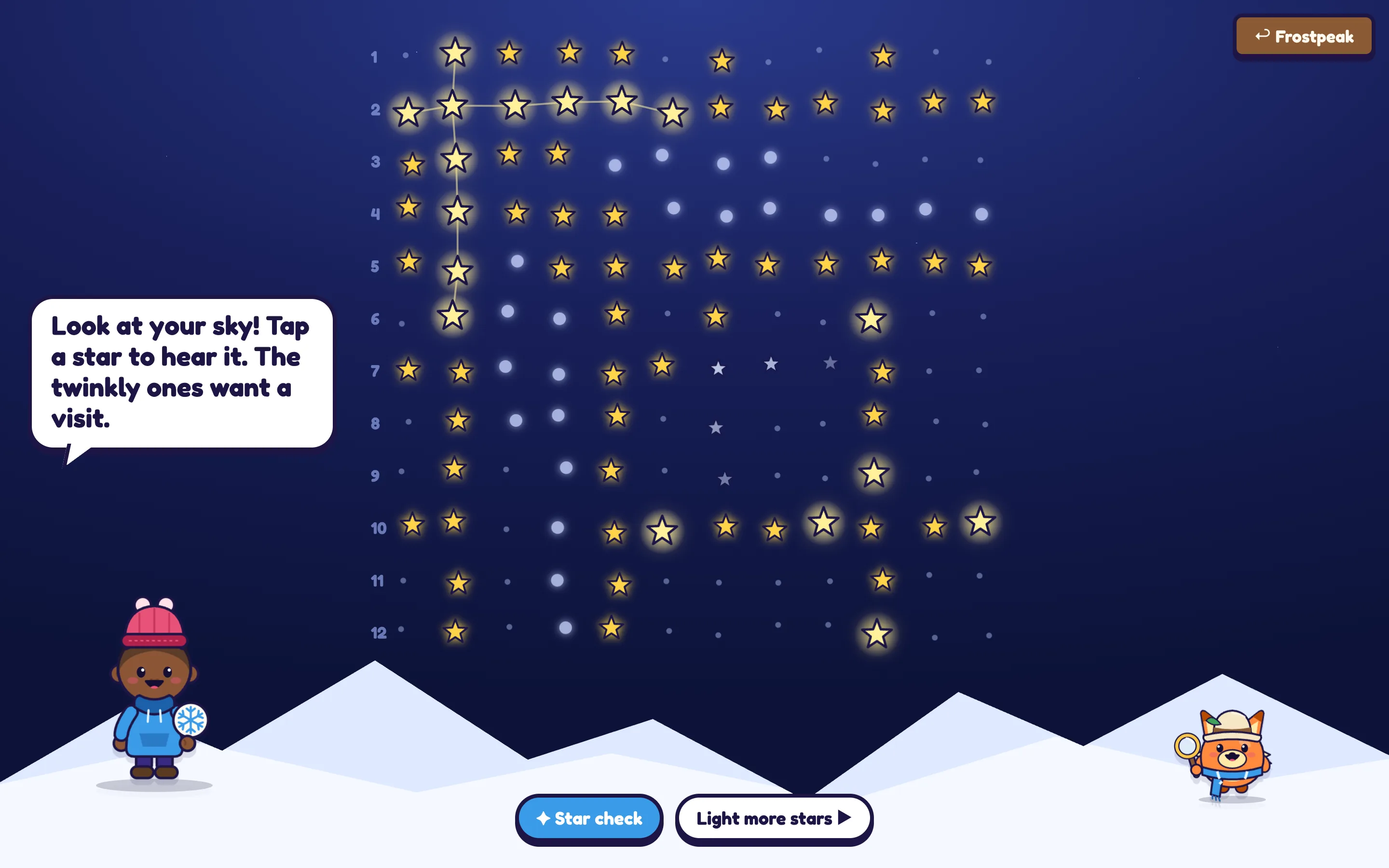
Each one comes from long-standing research on how memory works, and each is part of the rules of the games.
Children recall answers, many times, in short bursts. Recalling a fact strengthens it more than reading it again.
A fact they know comes back after three days, then a week, then two weeks. Facts that start to slip come first on the Today board.
Speed is measured on every answer, but a clock is only shown if the school allows it. Knows it by heart means quick on three different days across at least a week.
A fact they know but haven't practised for three weeks goes back to Nearly there and asks to be practised. The house it built stays standing.
The mixed and tricky-facts jobs put tables side by side, so children have to tell them apart.
Children see their own progress and shared class goals. Nobody is placed above anyone else, so a slower child isn't told they're losing.
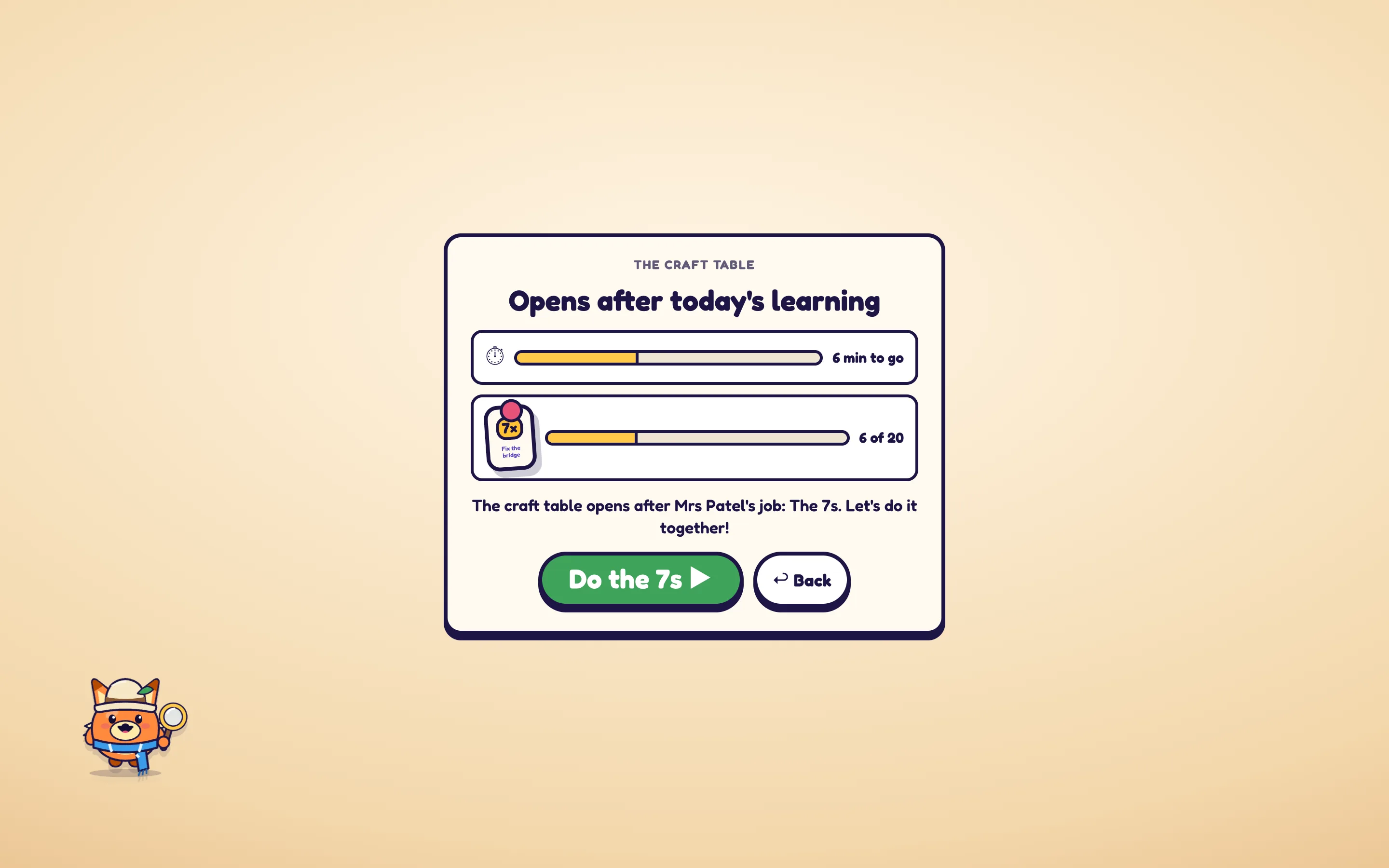
Building, decorating and making can wait until today's learning is done. A school or family chooses how firmly: a nudge from the Buddy, a ten-minute warm-up first, or making time earned minute for minute. Time only counts as learning while answers are coming in.
How the settings workOur pilot with schools in spring 2027 will measure how children's tables check practice scores change, and we'll publish the results. If your school would like to be part of it, tell us here.